 The latest update from QRiskValue on the status of the current market as of 03/25/11.
Monday, March 28, 2011
QRiskValue Chart
The latest update from QRiskValue on the status of the current market as of 03/25/11.


Thursday, March 24, 2011
Housing
Real vs Nominal Housing Prices: United States 1890-2010
From Naked Capitalism
I try to avoid republishing other people’s very cool charts, but this is on a pet blog topic. So you readers please be very nice and go look at the accompanying text at Visualizing Economics and better yet, subscribe too (hat tip Richard Smith, click to enlarge):
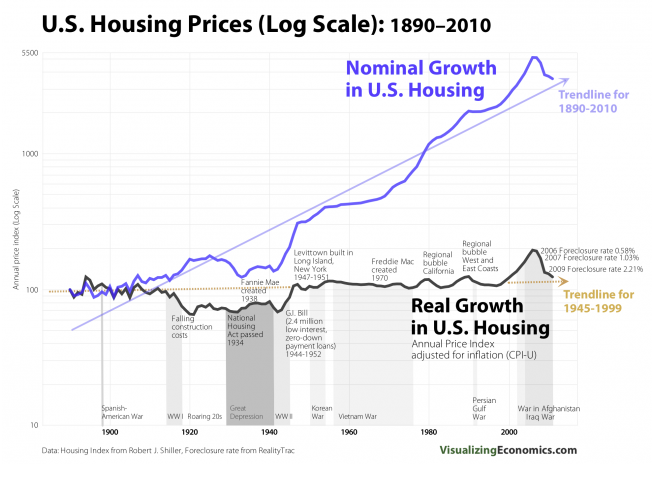
This serves to confirm the idea that from a policy standpoint, housing is best regarded as a forced savings vehicle or a store of value rather than an investment.
Tuesday, March 15, 2011
Once Clubbed Once Warned
Markets have been running hot for some time now with upside price distortions generated in large part by a Fed promoting asset price increases. The problems of large scale speculation across the board is that they become highly susceptible to event trauma. While Japan's problems are certainly off the charts, the principles of market declines from greater fool theory rallies is the same, ugly. Stories such as the amount of corporate cash on the sidelines, always the greatest hype extension, fade quickly as positions rapidly turn to red. As we learned in 2008, companies need all that cash when investors no longer want their stock.
Recent data showing broader participation in stocks by those once burned comes at a time when indexes have almost doubled. The fact that the pros are selling it to them and providing another clubbing is too amazing. Gold and agricultural commodities generate fascination but are doomed to fall to earth leaving the same morons looking at their statements with the same agony as their 401K brothers.
Recent data showing broader participation in stocks by those once burned comes at a time when indexes have almost doubled. The fact that the pros are selling it to them and providing another clubbing is too amazing. Gold and agricultural commodities generate fascination but are doomed to fall to earth leaving the same morons looking at their statements with the same agony as their 401K brothers.
Friday, March 4, 2011
Greenspan Recovery Plan X
Former Fed Chairman Greenspan believes stimulus programs are hampering the recovery. These thoughts are part of a history of mindless economic speak where Greenspan spins analysis from flawed observations. Since the economy is not growing fast enough, it must be because the current Fed does not see the obvious solution. Do nothing. Listen to Al. One of the great second guessers of all time. His response to being blamed in part for the economic downturn was, oh yeah, prove it.
Here is an article from the Washington Post.
Here is an article from the Washington Post.
Greenspan Says Government ‘Activism’ Hampering U.S. Recovery
March 3 (Bloomberg) -- Former Federal Reserve Chairman Alan Greenspan said a surge in U.S. government “activism,” including fiscal stimulus, housing subsidies and new regulations, is holding back the economic recovery.
Increased bond issuance by the Treasury Department crowds out borrowers with the weakest credit ratings, Greenspan said in an article in International Finance, published on the Web today. At least half of the shortfall in companies’ capital spending “can be explained by the shock of vastly greater government- created uncertainties embedded in the competitive, regulatory and financial environments” since the failure of Lehman Brothers Holdings Inc. in 2008, Greenspan said.
Greenspan’s conclusions fit with his long-held free-market ideology and may aid Republican lawmakers who argue that cutting federal spending now will help spur job growth. Critics including members of the Financial Crisis Inquiry Commission have said Greenspan’s failure to regulate the mortgage market last decade helped fuel the housing bubble whose bursting precipitated the financial crisis.
“Much intervention turns out to hobble markets rather than enhancing them,” said Greenspan, 84, who was appointed Fed chairman by Republican President Ronald Reagan in 1987 and served until 2006. “Any withdrawal of action to allow the economy to heal could restore some, or much, of the dynamic of the pre-crisis decade, without its imbalances.”
--Editors: Kevin Costelloe, Carlos Torres
Wednesday, March 2, 2011
Cuts Both Ways
Fed's Bernanke: Budget cuts could trim 200,000 jobs
(Reuters) - Federal Reserve Chairman Ben Bernanke said on Wednesday a Republican spending cut plan would not cause a big dent to U.S. economic growth, but could cost around 200,000 jobs.(Entire Article)
Sunday, February 27, 2011
Three Conditions On Who Should Listen To Warren Buffett
1. If you own stocks which were the top recipients of bailout money.
2. If you want to take advise from a billionaire whose company Berkshire Hathaway overall stock performance is down 10% over the last three years.
3. If you need a folksy patriotic advise from someone whose own personal life investment horizon might be measured in days but has a personal fortune of more than 45 billion.
2. If you want to take advise from a billionaire whose company Berkshire Hathaway overall stock performance is down 10% over the last three years.
3. If you need a folksy patriotic advise from someone whose own personal life investment horizon might be measured in days but has a personal fortune of more than 45 billion.
Saturday, February 26, 2011
How Investors Have Done:Source QRiskValue
| QRiskValue Analysis | ||||||||
| Since Jan 1 2008, how on average, trend, bargain hunters, and buy the dip investors have done. Data QRiskValue.com | ||||||||
Economic Slowdown
U.S. economic recovery threatened by events in Midwest, Middle East
Washington Post Neil Erwin and Michael A. FletcherJust when the economic recovery seemed to gain momentum, two new threats have emerged that could undermine it. One has flared in the Midwest, the other in the Middle East. (Entire Article)
Friday, February 25, 2011
Government Shutdown
Policy Paralysis
By Jonathan BernsteinUp until now, a government shutdown because of a stalemate over the budget was a strong possibility, but it didn’t appear inevitable. That’s because House Speaker John Boehner stands to be badly hurt by the train wreck a shutdown would be, and I’m confident—from what he’s said and because he was around the last time it happened—that he realizes it. But his decision last week during House consideration of the must-pass spending bill to open up the floor to unlimited amendments reframed the issue in a way that gives Boehner much less room for compromise.
(From The New Republic) Entire Article
Subscribe to:
Posts (Atom)